



Jantar Mantar Jaipur: Where Stone Meets the Stars
In the heart of Jaipur’s bustling old city, just beside the City Palace, stands a place that looks like a playground of massive stone sculptures. But don’t be fooled by appearances this is the Jantar Mantar, one of the most advanced and beautiful astronomical observatories ever built. It’s a UNESCO World Heritage Site and a silent tribute to India’s scientific and cultural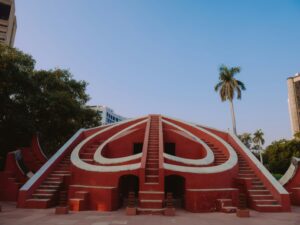 brilliance.
Built in the 18th century, Jantar Mantar is not just a collection of instruments it’s an experience. Each structure was designed to read the skies, track stars, measure time, and even predict eclipses, centuries before modern tools existed. If you’re planning a visit to Jaipur, this is not just another stop; it’s where math, astronomy, and architecture come together to create pure magic.
A Vision Beyond His Time: Jai Singh II
Jantar Mantar was the brainchild of Maharaja Sawai Jai Singh II, the founder of Jaipur and a man with a passion for science. At a time when rulers were more focused on conquests and
palaces, Jai Singh was studying astronomy in Arabic, Persian, Sanskrit, and Greek
texts. He believed that the small brass instruments of the time were too inaccurate and that larger, stone-based tools would offer more precision.
Between 1724 and 1734, he built five observatories across India—in Delhi, Ujjain, Mathura, Varanasi, and Jaipur. The one in Jaipur is the largest and most complete of them all. With 19 massive instruments, each crafted for a specific astronomical purpose, it remains a marvel of scientific engineering even today.
Instruments That Still Measure the Cosmos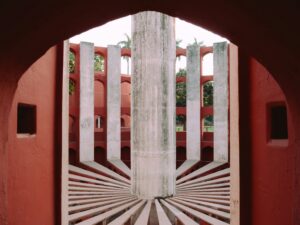
Walking into Jantar Mantar feels like stepping inside a grand, open-air laboratory. The instruments are not just symbolic they still work, and some are precise enough to amaze even today’s astronomers.
The Samrat Yantra, the world’s largest sundial, towers at 27 meters. It’s shaped like a huge triangle, casting a sharp shadow that moves at a rate of 1 millimeter per second. It can tell the local time to an accuracy of about two seconds. Watching the shadow shift in real-time is strangely hypnotic.
Then there’s the Jai Prakash Yantra, two large sunken bowls with marble markings and crosswires. These were designed to project the sky onto the earth’s surface, allowing the observer to calculate the exact position of celestial bodies. The sheer design of this instrument—one concave, one convex—is a blend of logic and art.
The Rama Yantra is another gem—two large cylindrical structures open to the sky. Step inside, and you can literally track the altitude and direction of stars. Other instruments like the Narivalaya, Chakra Yantra, and Digamsa calculate everything from solar declination to equinox timings.
What makes these instruments exceptional isn’t just their accuracy—it’s that they are entirely analog, powered only by sunlight, shadow, angles, and the brilliance of geometry.
Where Science Becomes Art
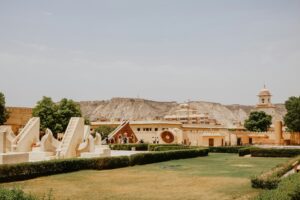
Jantar Mantar isn’t a dry scientific site it’s deeply aesthetic. Each instrument is made of stone and marble, shaped with beautiful curves and sharp angles. The entire complex is aligned with astronomical north, designed according to ancient principles of Vedic and Islamic astronomy, and built with mathematical precision.
The symmetry and elegance of these instruments draw photographers, architecture lovers, and historians from across the world. The site looks stunning against Jaipur’s blue sky, especially in the golden morning and evening light.
For centuries, astronomy in India was closely tied to astrology. Jantar Mantar was also used to calculate auspicious dates for festivals, farming, ceremonies, and even royal battles. It wasn’t just about science it was about how science met everyday life.
The Legacy of Jai Singh Lives On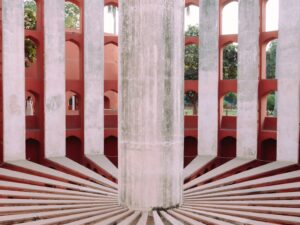
Maharaja Jai Singh didn’t stop at building monuments. He created astronomical tables more accurate than most European ones at the time and corresponded with scholars from France, Persia, and Portugal. His work reflects a time when India wasn’t just participating in science it was leading.
Although modern telescopes and digital tools have long replaced these instruments for formal astronomy, Jantar Mantar remains relevant. It’s used for education, demonstrations, and inspiring the next generation of thinkers. More importantly, it reminds us that progress can be carved in stone literally.
Your Visit to Jantar Mantar: Practical Info
A visit to Jantar Mantar is more than a sightseeing stop it’s a walk through time, science, and imagination. It’s located in central Jaipur, within easy reach of other iconic landmarks like City Palace and Hawa Mahal. Many travelers combine these three into a single half-day tour.
You’ll find certified guides and audio tours available, offering deep insights into how each instrument works. Most guides explain the site in a simple and engaging way even if you don’t know much about astronomy, you’ll still find yourself amazed.
Jantar Mantar is open daily from 9:00 AM to 4:30 PM. Ticket prices are modest:
If you prefer a smooth experience, many Jaipur city tours include Jantar Mantar in our package, often along with private drivers, guides, and visits to other top spots .
.
Why This Place Should Be on Your List
Of all the wonders in Rajasthan, Jantar Mantar Jaipur stands apart. It’s not a fort, palace, or temple it’s a bridge between heaven and earth. It proves that India’s heritage is not just about kings and battles, but also about ideas, innovation, and discovery.
Whether you’re a history lover, photographer, student, or simply curious traveler, Jantar Mantar offers a deep, thoughtful experience. You won’t just see shadows move you’ll see the ambition of a king, the brilliance of a civilization, and the eternal dance of the cosmos carved in stone.
Want to Add Jantar Mantar to Your Jaipur Tour?
We specialize in custom city tours with private cars and expert guides, covering Jantar Mantar and other gems of Jaipur. Reach out to plan a stress-free, immersive Jaipur experience with us.
Call us at: +91 9818975829
Explore our tours: india-custom-tours.com