



City Palace Jaipur – The Beating Heart of Rajasthan’s Royal Heritage
More Than a Monument : A Living Royal Legacy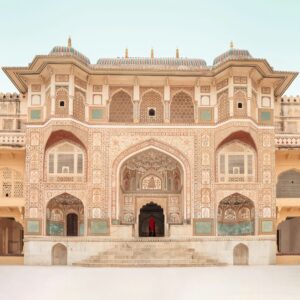
In the heart of Jaipur’s walled city stands a masterpiece that transcends time: The City Palace Jaipur. Unlike ordinary tourist attractions, this iconic landmark is not just a glimpse into India’s regal past it’s a living embodiment of power, artistry, and heritage. Built in 1727, during the reign of Maharaja Sawai Jai Singh II, this palace was conceived not as an isolated structure, but as the cultural and administrative nucleus of the Pink City itself.
Today, the City Palace remains one of Jaipur’s most visited tourist attractions, drawing in travelers, historians, photographers, and culture seekers from around the globe. But more than its aesthetic appeal, it holds what every modern visitor seeks: authenticity, immersive history, and an atmosphere that genuinely connects you with the soul of Rajasthan.
The Vision of a King: City Palace as the Soul of Jaipur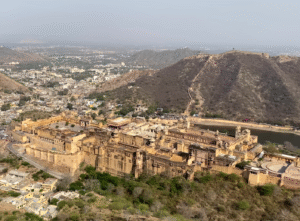
The construction of City Palace was no ordinary architectural project. Maharaja Sawai Jai Singh II, a ruler known equally for his strategic intellect and scientific temperament, founded Jaipur as India’s first planned city. The palace he envisioned was to be the cornerstone of this urban design both functionally as a seat of governance and symbolically as a representation of Rajput valor and cultural elegance.
Blending Rajputana fortification elements with Mughal aesthetics and refined touches of European design, the City Palace set a new benchmark for Indo-Islamic architecture. Its symmetrical courtyards, intricately carved gateways, and ornate domes were not only built to impress, but to inspire a statement of Rajasthan’s place in the subcontinent’s evolving political and cultural narrative.
Architectural Identity: A Fusion That Tells a Thousand Stories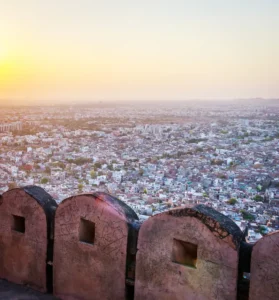
The City Palace is a visual symphony. Its exterior walls rise with strength and simplicity, reminiscent of Rajput fortresses, while the interiors soften with the graceful ornamentation of Mughal-influenced frescoes, jaalis (latticed windows), and chhatris (elevated pavilions). European nuances are subtly layered in the geometric harmony, stained glass, and classical colonnades add an unexpected elegance that bridges East and West.
This architectural synthesis is not accidental. It reflects the diplomacy and sophistication of the Jaipur royals, who embraced diverse cultural influences while preserving their own identity. Every arch, courtyard, and ceiling was designed to evoke a sense of order, grandeur, and purpose.
Inside the City Palace: An Immersive Royal Experience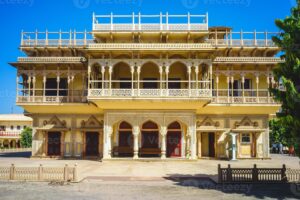
Stepping into the City Palace is like entering a well-preserved time capsule an environment where every corner has a story and every structure serves a symbolic or functional role.
The Mubarak Mahal, once used to welcome foreign dignitaries, now functions as a textile museum showcasing rare fabrics, hand-embroidered royal attire, and even the famously massive garments of Maharaja Madho Singh I, who reportedly weighed over 250 kilograms. This space not only displays royal taste but also the evolution of craftsmanship in Rajasthani textiles.
Further inside, the Chandra Mahal stands as the most sacred wing of the complex. Though largely occupied by the present-day royal family, selected rooms such as the Sukh Niwas and the Blue Room are accessible to the public and offer an opulent glimpse into the past complete with mirror-inlaid ceilings, floral frescoes, and walls decorated in 22-carat gold. Interestingly, the royal flag hoisted on this Mahal changes to signify the presence of the Maharaja, a tradition that persists even today.
The Pritam Niwas Chowk, or the Peacock Courtyard, is the crown jewel of City Palace’s visual narrative. Here, four exquisitely painted doorways represent the four seasons and are deeply rooted in Hindu cosmology. The Peacock Gate, in particular, with its vivid blues and emeralds, is among the most photographed locations in India a fusion of art, devotion, and symbolism.
The Diwan-i-Khas, or Hall of Private Audience, is another unmissable highlight. It houses the largest sterling silver vessels in the world each crafted from over 14,000 melted silver coins. These urns, once carried to London filled with sacred Ganga water by Maharaja Sawai Madho Singh II, are more than showpieces they’re icons of spiritual and cultural integrity.
Beyond the Walls: Stories That Live On
Unlike static heritage sites, the City Palace continues to pulse with life. It has hosted everything from state ceremonies to royal weddings, diplomatic summits to spiritual festivals. It was here that Queen Elizabeth II, Jacqueline Kennedy, and numerous global dignitaries experienced the unparalleled hospitality of Rajasthan.
Maharaja Sawai Man Singh II, a former ruler, played a pivotal role in modernizing the palace and transforming it into a cultural interface between East and West. A champion polo player and respected diplomat, his legacy is deeply entwined with the City Palace’s status as both a royal residence and public heritage site.
What truly sets the City Palace apart is that the royal lineage continues to live within its premises. This rare coexistence of public museum and private residence gives the palace its living character something few monuments around the world can claim.
Why City Palace is a Must-Visit on Every Rajasthan Itinerary
Visiting the City Palace is not about ticking off a tourist checklist it is about experiencing the essence of Jaipur. From a storytelling standpoint, it provides a layered understanding of royal history, architectural innovation, and the continuity of culture. From an emotional perspective, it offers an atmosphere that balances serenity with splendor.
Whether you’re an architecture enthusiast, a historian, a travel photographer, or simply someone captivated by India’s regal past, the City Palace offers value far beyond its walls. The visual textures, ambient music, fluttering flags, and marble echoes create an unforgettable sensory and cultural experience.
Visitor Information for City Palace Jaipur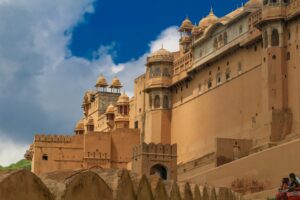
Located in the Old City near the famed Badi Chaupar, the City Palace is easily accessible and central to other must-see Jaipur attractions like the Hawa Mahal and Jantar Mantar. The palace is open daily from 9:30 AM to 5:00 PM, and extended evening hours are available with special tickets.
Entry fees vary for Indian and foreign tourists, with composite tickets available that grant access to more private areas like the Royal Darbar, Blue Room, and Chandra Mahal. Hiring a local guide or using an audio tour is highly recommended to get the most out of your visit, especially for those seeking a deeper narrative behind the architecture and artifacts.